Monument Guide · 2026
El Castillo, Chichen Itza: The Kukulkan Pyramid Explained
Height, steps, calendar design, the equinox serpent, the hidden pyramid inside and how to see the Temple of Kukulkan on a day trip.
El Castillo at a glance
What is El Castillo at Chichen Itza?
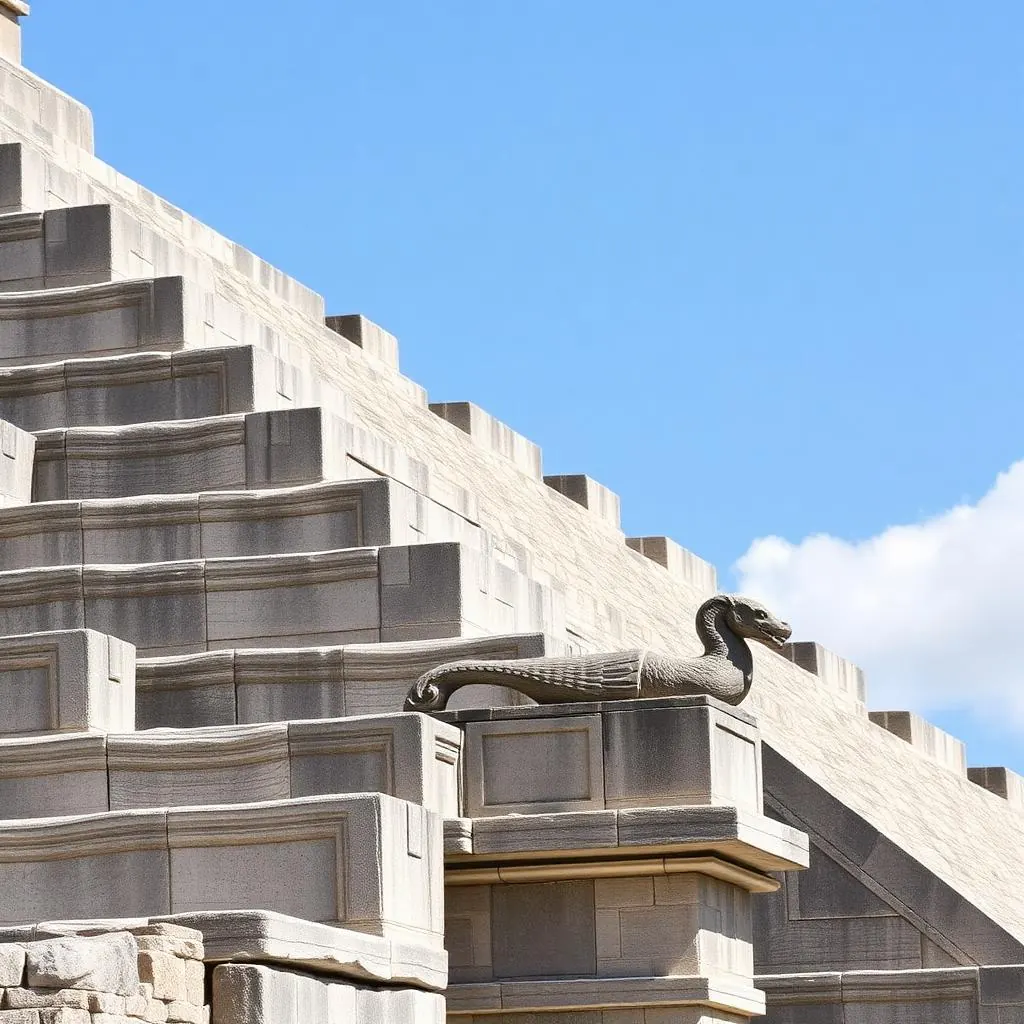
El Castillo is the step pyramid at the centre of the main plaza at Chichen Itza, the building that made the site one of the New Seven Wonders of the World. Archaeologists know it as the Temple of Kukulkan, named for the feathered serpent deity honoured inside, and it was completed over an earlier structure between the 9th and 12th centuries.
Its names
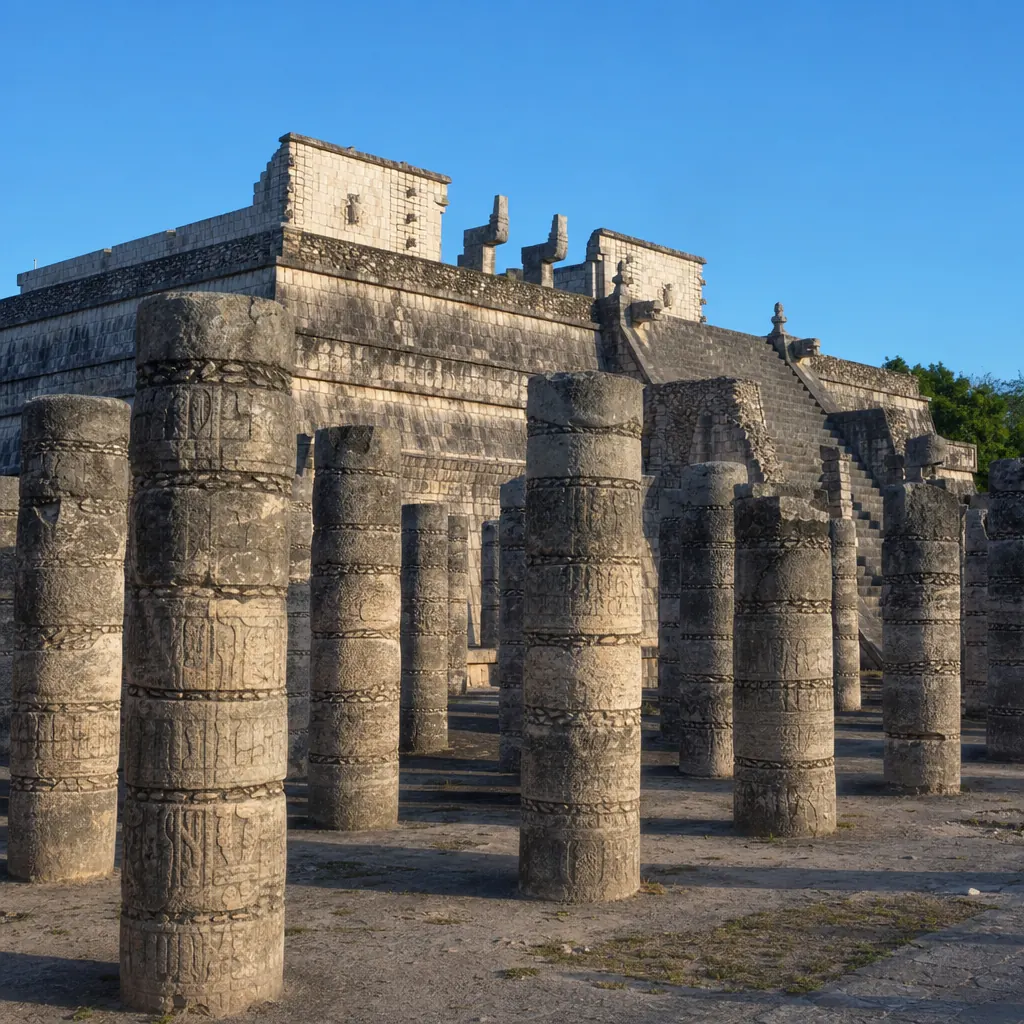
El Castillo is the Spanish name given by early visitors and means 'the castle'. Archaeologists call it the Temple of Kukulkan. Many guides say Kukulkan Pyramid or Pyramid of Kukulcan. All four names describe the same building.
Who it honours
Kukulkan is the feathered serpent deity of the Yucatec Maya, linked to wind, rain, renewal and rulership. Carved serpent heads sit at the foot of the north staircase.
When it was built
The pyramid you see today was completed during the city's most influential period, roughly between the 9th and 12th centuries, on top of an earlier structure.
What it was for
It was a temple and a ceremonial stage. The plaza around it held large gatherings, and the building itself worked as a public statement of calendar knowledge and royal power.
El Castillo Size, Height and Steps
El Castillo Size, Height and Steps covers the numbers behind the Kukulkan pyramid, unusually exact for an ancient building. The pyramid rises about 24 metres, or 30 metres with its temple, on a base near 55 metres per side. Four staircases of 91 steps each total 365 with the shared top platform, matching the days of the Maya year.
Height
The pyramid body rises about 24 metres (79 feet). With the temple on the top platform the total is about 30 metres (98 feet).
Base
The square base measures roughly 55.3 metres (181 feet) on each side, set on a low platform in the middle of the great plaza.
Nine terraces
Each face is built from nine stacked terraces, split by the central staircase into 18 sections per side.
365 steps
Each of the four staircases has 91 steps. Four times 91 is 364, and the shared platform at the top makes 365, one for each day of the solar year.
52 panels
Each side carries 52 recessed panels, matching the 52-year calendar round when the 260-day and 365-day Maya calendars realign.
Orientation
The pyramid is turned slightly off the cardinal points so the north staircase catches the late-afternoon sun that produces the equinox shadow.
| Feature | Measurement | What it means |
|---|---|---|
| Total height | About 30 m (98 ft) with the temple | Includes the temple sitting on the top platform |
| Base width | About 55.3 m (181 ft) per side | The pyramid sits on a square base |
| Terraces | 9 per face, 18 sections | The central staircase splits each face into two sets of nine |
| Steps per staircase | 91 | Each of the four staircases has the same count |
| Total steps | 365 with the top platform | Matches the haab', the Maya solar year |
| Wall panels | 52 per side | Matches the 52-year calendar round |
| Orientation | Turned off the cardinal points | Produces the equinox shadow effect on the north staircase |
The Kukulkan Pyramid as a Maya Calendar
The Kukulkan pyramid works as a calendar in stone, not as a decorative claim but as a measurable feature of its architecture. Its 365 steps mirror the haab', the Maya solar year of 18 months of 20 days plus five extra days. Its 52 wall panels match the calendar round, the 52-year cycle where the solar and ritual calendars realign.
The haab'
The 365-step total mirrors the haab', the Maya solar year of 18 months of 20 days plus a short 5-day period.
The tzolk'in
The 260-day ritual calendar runs alongside the solar year. The two only line up again after 52 years, the figure encoded in the wall panels.
18 terrace sections
The 18 terrace sections per side match the 18 named months of the haab'.
Astronomy on site
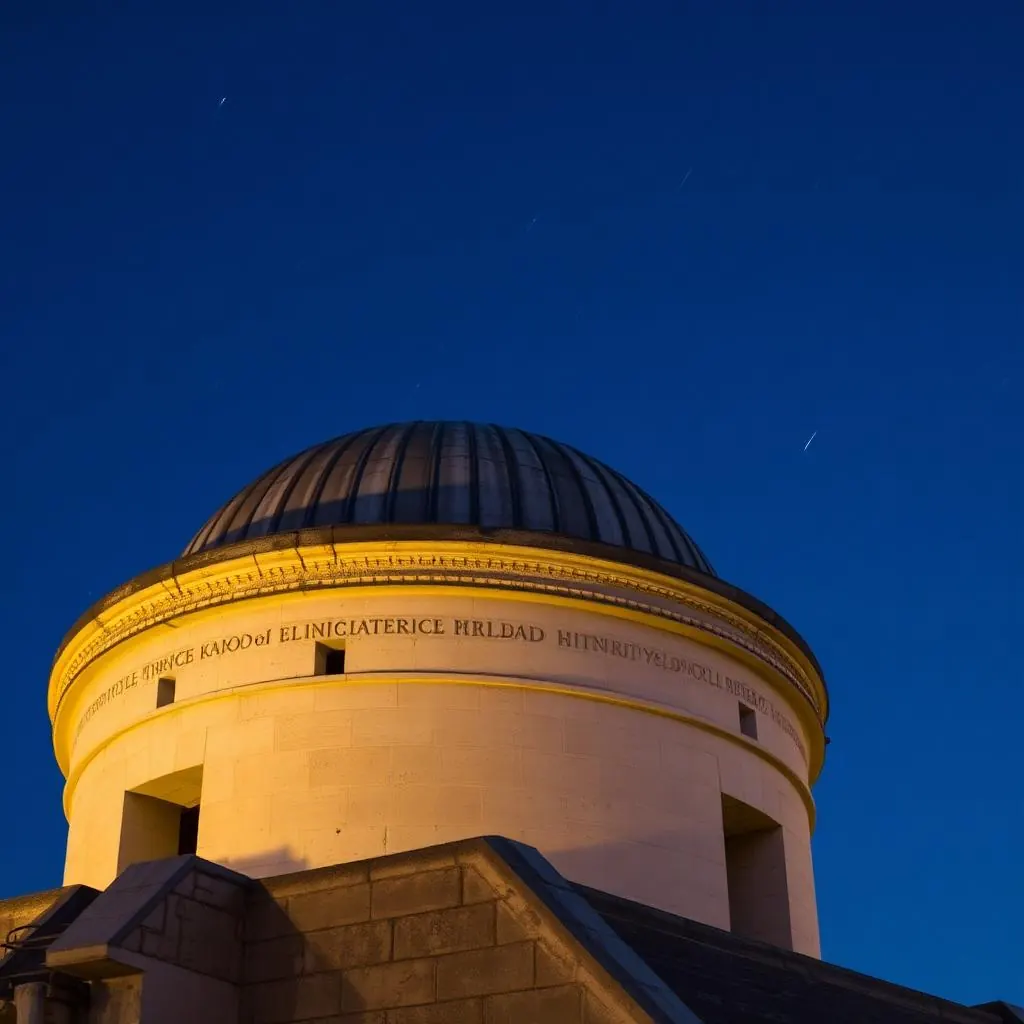
Calendar design here connects to the wider astronomical work visible at El Caracol, the round observatory a short walk south.
The Serpent of Light and Shadow
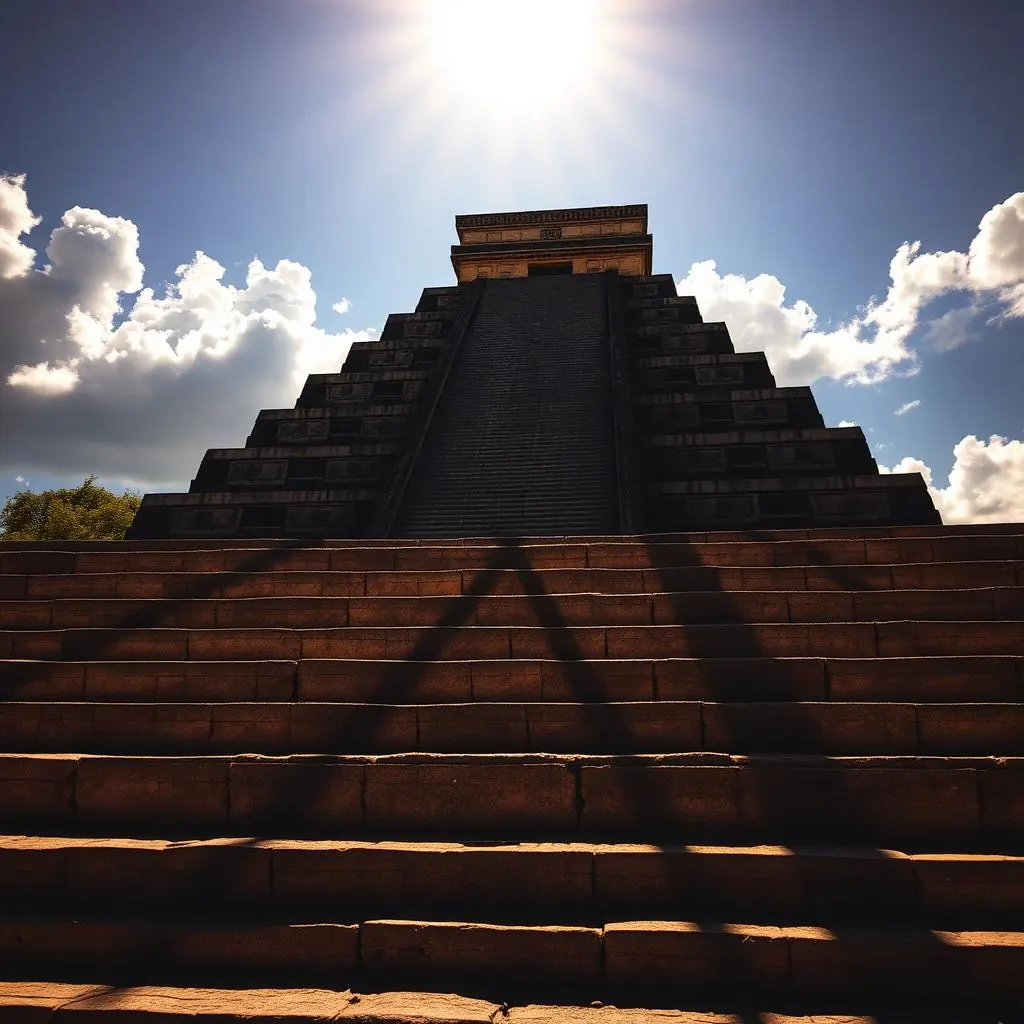
The Serpent of Light and Shadow is the effect seen around the equinoxes, when the corners of the nine terraces throw triangles of shadow onto the north balustrade of El Castillo. The pattern reads as a serpent sliding down toward the carved stone heads at the base of the staircase. Full dates and viewing advice are in the Chichen Itza equinox guide.
When it happens
Best around 20 to 21 March and 22 to 23 September, and visible in a weaker form for several days either side.
What time
Late afternoon, usually between about 3pm and 5pm, when the sun is low enough to raise the shadow triangles.
What you need
A clear sky. Cloud cover erases the effect completely, which is why the display is never guaranteed on a given date.
Crowds
Equinox week is the busiest period of the year at the site. Arriving at opening and staying through the afternoon is the practical approach.
The Pyramid Inside the Pyramid
El Castillo hides at least one earlier pyramid inside its core, built when the Maya enlarged existing temples rather than replacing them. Excavations in the 1930s reached a smaller inner pyramid with its own staircase and a chamber holding a red jaguar throne and a Chac Mool figure. Later surveys suggested a third, older structure at the very centre.
The inner temple
Excavations in the 1930s reached a smaller pyramid within the outer one, with its own staircase and a temple chamber.
The jaguar throne
Inside that chamber sits a red jaguar throne with jade inlays, along with a Chac Mool figure. Both are among the best known finds at the site.
A third structure
Later electrical-resistivity surveys suggested a still smaller, even older structure at the very centre, so the building may hold three pyramids in sequence.
The cenote below
Geophysical studies also mapped a water-filled cenote under the pyramid, which fits the Maya idea of building over sacred openings to the underworld.
Access
The interior tunnel is closed to the public for conservation and safety, so the inner pyramid is seen only in museum displays and photographs.
The Acoustics of El Castillo
The acoustics of El Castillo produce a distinct chirp echo when a visitor claps once at the base of the north staircase. Sound bouncing between the deep, narrow steps returns at a falling pitch that many people compare to the call of the quetzal bird. Acousticians have measured the effect and trace it directly to the step geometry.
The chirp echo
Sound bouncing between the deep, narrow steps returns at a falling pitch that many people compare to the call of the quetzal bird.
Studied effect
Acousticians have measured and modelled the echo, and it follows directly from the step geometry rather than from any hidden chamber.
Intentional or not
Researchers still debate whether the Maya designed the effect deliberately. Either way it was part of how the plaza sounded during ceremonies.
Try it yourself
Guides usually demonstrate it. Early morning is best, before the plaza fills and background noise covers the return.
Can You Climb El Castillo Today?
No, climbing El Castillo has not been allowed since 2006, after decades of foot traffic wore down the steps and a fatal fall ended public access for good. The National Institute of Anthropology and History enforces the ban, and visitors walk the plaza around the pyramid and photograph it from every side. No structure at Chichen Itza is climbable today.
Why it closed
Decades of foot traffic wore down the steps, and a fatal fall in 2006 ended public access for good.
What you can do
You can walk the full plaza and photograph the pyramid from every side. Rope lines keep visitors a short distance from the base.
Other structures
Climbing is also off limits on the Temple of the Warriors and the Osario. Nothing at Chichen Itza is climbable today.
If you want to climb
Coba's Nohoch Mul closed in 2020, so most Yucatan climbing options are gone. The comparison is covered in the Chichen Itza vs Coba vs Tulum guide.
How to See El Castillo on a Visit
El Castillo is the first monument reached after the entrance gate, so it makes sense to plan the rest of a visit around it. Arriving at the 8am opening gives soft light on the north face and fewer crowds in photos. Check the opening hours guide before setting out, since gate times affect how much of the site fits into one visit.
Arrive at opening
The gate opens at 8am. The first hour gives soft light on the north face and far fewer people in your photos.
Best photo angle
The north-west corner shows two faces at once and includes the serpent heads at the foot of the staircase.
Time needed
Allow about 30 minutes at the pyramid itself and two to three hours for the whole archaeological zone.
Getting there
Most visitors come on a day trip. See how to get to Chichen Itza or book a guided Chichen Itza tour that explains the pyramid on site.
Nearby monuments
The Great Ball Court is a two-minute walk west and the Temple of the Warriors sits directly east of the pyramid.
See El Castillo with a certified local guide
Day trips from Cancun, Playa del Carmen, Tulum, Riviera Maya and Merida with hotel pickup, entrance tickets handled and a guide who explains the pyramid step by step.
Plan my visit on WhatsApp